
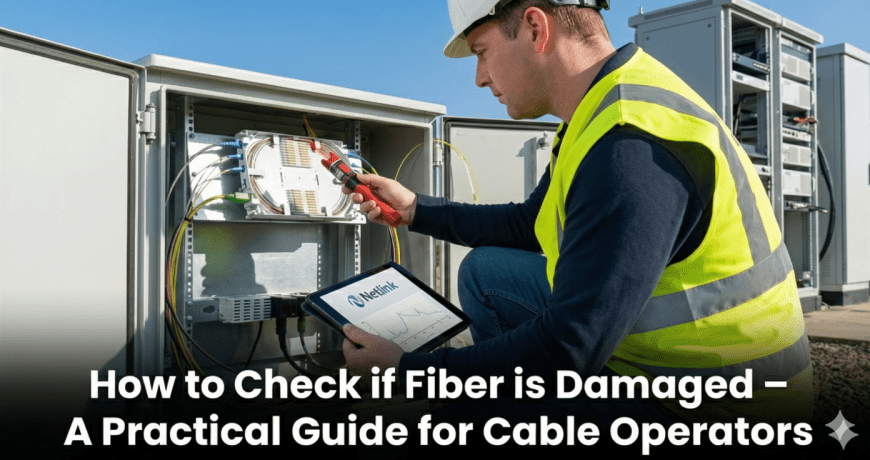
How to Check if Fiber is Damaged – A Practical Guide for Cable Operators, Powered by Netlink – Your Trusted FTTH Partner Leave a comment
How to Check if Fiber is Damaged – A Practical Guide for Cable Operators
Powered by Netlink – Your Trusted FTTH Partner
In FTTH networks, even a small issue in the fiber line can cause huge service disruptions. Most customer complaints—low speed, LOS indications, or frequent disconnections—trace back to one core problem: damaged fiber.
Every cable operator faces this challenge. The good news? Diagnosing fiber damage is simple when you use the right tools and follow the right method. In this guide, we’ll walk through the three most reliable techniques to identify fiber damage and how Netlink products help you maintain a stable and professional network.
1️⃣ Use a Visual Fault Locator (VFL) – Quick & Effective
A VFL is the fastest and easiest way to detect damage in a fiber, especially during outdoor or house-to-house checks.
The laser light travels through the fiber and reveals problems instantly:
✔ Fiber breaks
✔ Sharp bends
✔ Microbends
✔ Improper splicing
✔ Crushed sections in drop cables
When the beam leaks or glows at a point, that’s your problem area.
Why Netlink?
Netlink offers premium-quality bend-insensitive fibers and durable drop cables that reduce damage and breakage. Even if issues happen, Netlink’s fibers show clear fault visibility, making your VFL testing more accurate.
2️⃣ Use an OTDR for Accurate Testing – Professional Level Verification
A VFL is great for quick checks, but when you need high accuracy—especially for long-distance fiber—nothing beats an OTDR (Optical Time Domain Reflectometer).
An OTDR helps you identify:
✔ Exact distance of the break
✔ Splice loss
✔ Connector loss
✔ Bend losses
✔ Fiber health over long routes
✔ Overall link quality
This is extremely helpful during backbone maintenance, long-distance FTTH routes, or when customers complain about power issues without visible physical damage.
How Netlink Helps
Netlink components like:
-
Low-loss patch cords
-
High-grade ODF boxes
-
Engineered splitters
-
Bend-insensitive fibers
ensure that OTDR readings remain clean, accurate, and consistent. When you use poor-quality materials, OTDR graphs become noisy and misleading. Netlink eliminates this risk.
3️⃣ Look for Tight Bends or Crushed Points Along the Cable
One of the most common causes of power loss in FTTH networks is tight bends.
Fiber bends beyond the minimum radius can lead to:
❌ Attenuation
❌ LOS issues
❌ ONT speed drops
❌ Intermittent signal
Similarly, crushed cables from door pressure, staples, or rough installations lead to micro-cracks that are invisible to the eye but dangerous for fiber performance.
The Netlink Advantage
Netlink provides bend-insensitive, high-flexibility fiber that significantly reduces bend losses. Our drop cables are:
✔ Strong
✔ Durable
✔ UV-resistant
✔ Designed for Indian and Gulf climate conditions
This means fewer crushed fibers, less power drop, and fewer complaints.
Why Fiber Damage Checking is Essential for Every Cable Operator
Ignoring fiber damage or using low-quality materials leads to:
❌ Frequent complaints
❌ Poor speed
❌ LOS
❌ Higher maintenance costs
❌ Customer loss
But with the right testing tools and reliable products, you can keep your FTTH network strong and complaint-free.
Build a Damage-Free Network With Netlink
At Netlink, we don’t just sell FTTH products—we help cable operators build networks that last. Our complete range includes:
🔵 Drop cables
🔵 Patch cords
🔵 Splitters
🔵 ONTs
🔵 OLTs
🔵 Enclosures
🔵 Adapters
🔵 Patch panels
🔵 And more…
All engineered for low loss, high stability, and long life.
Whether you’re laying a new network or solving customer complaints, Netlink products give you the performance you can trust.
Final Takeaway
To check if fiber is damaged:
-
✔ Use a VFL for quick detection
-
✔ Use an OTDR for detailed analysis
-
✔ Physically inspect for bends & crushed points
And to prevent these issues from happening again, always choose high-quality FTTH components from Netlink.