
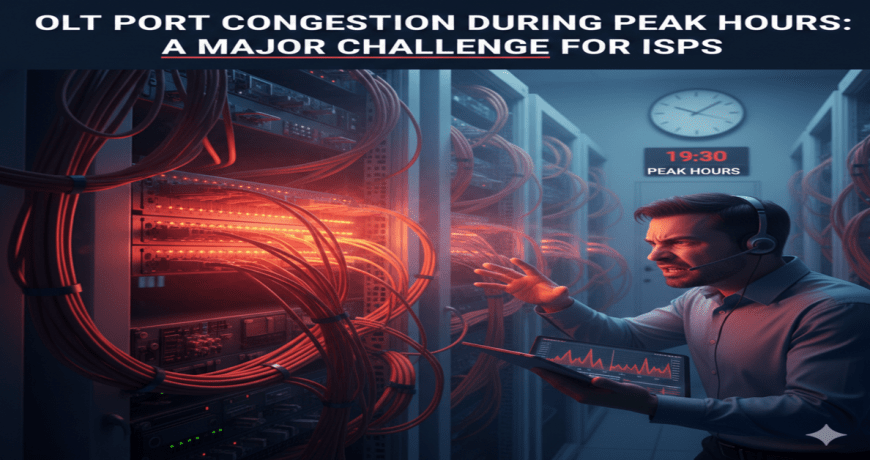
OLT Port Congestion During Peak Hours: A Major Challenge for ISPs Leave a comment
OLT Port Congestion During Peak Hours: A Major Challenge for ISPs
OLT port congestion during peak hours is one of the most common performance issues faced by ISPs and cable operators. As broadband usage continues to rise—especially during evenings when users stream videos, attend online classes, and work remotely—network load increases significantly.
When OLT ports are not properly planned or scaled, congestion occurs, resulting in slow speeds, buffering, and customer dissatisfaction.
What Is OLT Port Congestion?
OLT port congestion happens when too many ONTs or subscribers are connected to a single OLT port, exceeding its bandwidth capacity. During peak usage hours, this leads to:
-
Reduced internet speeds
-
Increased latency
-
Packet loss
-
Service instability
This issue is especially common in rapidly growing FTTH networks where subscriber additions outpace infrastructure upgrades.
Why OLT Port Congestion Occurs During Peak Hours
Several factors contribute to OLT port congestion during peak hours:
-
High subscriber-to-port ratio
-
Poor bandwidth planning
-
Over-subscription without traffic management
-
Increased OTT and IPTV consumption
-
Lack of timely OLT expansion
-
Outdated or low-capacity OLT hardware
Without proactive capacity planning, congestion becomes unavoidable as user demand grows.
Impact of OLT Port Congestion on ISPs & Customers
OLT port congestion directly affects both service quality and business performance:
-
Slow internet speeds during evening hours
-
Buffering and poor OTT streaming experience
-
Increased customer complaints and support tickets
-
Higher churn rates
-
Damage to ISP brand reputation
-
Difficulty in acquiring new subscribers
In competitive markets, even temporary peak-hour issues can push customers to switch providers.
Best Practices to Reduce OLT Port Congestion
ISPs can effectively manage and reduce congestion by following these proven strategies:
1. Proper Bandwidth Planning
Accurately calculating bandwidth requirements based on subscriber usage patterns helps prevent overload.
2. Optimize Split Ratios
Maintaining balanced split ratios ensures fair bandwidth distribution among users connected to the same OLT port.
3. Upgrade OLT Capacity
Using high-performance OLTs with sufficient uplink capacity helps handle growing traffic demands.
4. Deploy Quality ONTs
Efficient ONTs ensure better bandwidth utilization and reduce unnecessary load on OLT ports.
5. Monitor Traffic in Real Time
Active network monitoring allows ISPs to detect congestion early and take corrective action.
How Netlink Helps ISPs Overcome OLT Port Congestion
Netlink understands the operational challenges ISPs face in managing high subscriber density and peak-hour traffic. Our FTTH solutions are designed to support scalable, high-performance networks.
Netlink Advantages for ISPs:
-
ISP-grade ONTs compatible with major OLT brands
-
Reliable FTTH components ensuring efficient bandwidth usage
-
Consistent product quality for stable network performance
-
Fast availability to support network expansion
-
Technical guidance for capacity planning and deployment
With Netlink’s solutions, ISPs can confidently expand their subscriber base without compromising peak-hour performance.
Turning Peak-Hour Challenges into Growth Opportunities
Peak-hour congestion is a sign of growing demand—not failure. ISPs that invest in the right infrastructure and technology can convert this challenge into a competitive advantage.
By partnering with Netlink, ISPs can:
-
Improve peak-hour network stability
-
Deliver consistent user experience
-
Reduce customer complaints
-
Strengthen long-term network scalability
Conclusion
OLT port congestion during peak hours is a critical issue that demands proactive planning and reliable network components. With proper bandwidth management and trusted partners, ISPs can ensure uninterrupted service—even during high-traffic periods.
Netlink is committed to helping ISPs build high-capacity, future-ready FTTH networks that perform when it matters most.