
What Should Be the Maximum Distance Between OLT and ONT in a Fiber Network? Leave a comment
What Should Be the Maximum Distance Between OLT and ONT in a Fiber Network?
Introduction
In fiber optic networks, the connection between the Optical Line Terminal (OLT) and the Optical Network Terminal (ONT) plays a crucial role in delivering high-speed internet to users. The distance between these two devices directly affects network performance, signal strength, and reliability. For Internet Service Providers (ISPs), understanding the ideal distance between OLT and ONT is essential for building a stable and efficient fiber network.
Understanding OLT and ONT
The Optical Line Terminal (OLT) is the central device located at the service provider’s facility or central office. It manages and distributes fiber connections to multiple users in the network.
The Optical Network Terminal (ONT) is installed at the customer’s location. It converts the optical signals coming from the fiber cable into electrical signals that can be used by routers, computers, and other devices.
Together, these two devices form the backbone of Fiber-to-the-Home (FTTH) networks.
Maximum Distance in GPON Networks
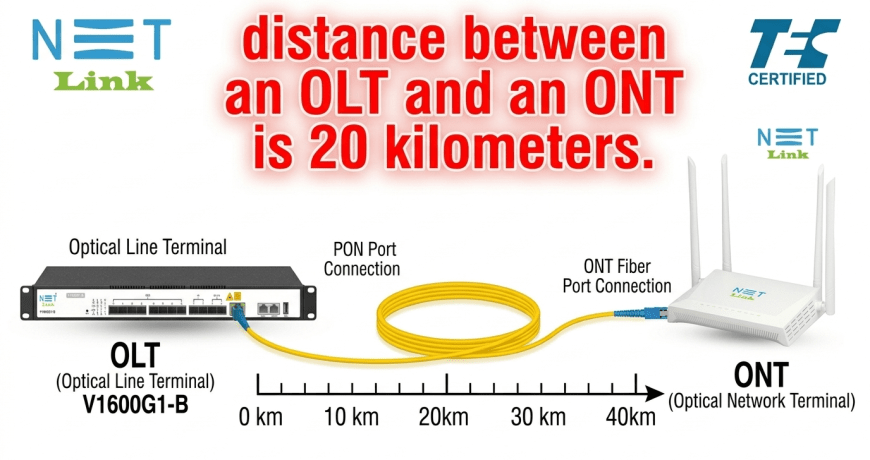
In most GPON networks, the maximum supported distance between an OLT and an ONT is 20 kilometers. This is the standard range defined for GPON technology under normal operating conditions.
Within this distance, the network can maintain stable signal transmission and provide reliable internet connectivity to users.
However, the actual working distance may vary depending on several factors such as fiber quality, splitter configuration, and optical power budget.
Factors That Affect the OLT-ONT Distance
1. Optical Power Budget
The optical power budget determines how much signal loss the network can tolerate. Every fiber cable, connector, and splitter causes some signal attenuation. If the total loss exceeds the power budget, the connection may become unstable.
2. Split Ratio
In GPON networks, one OLT port can be split to serve multiple ONTs. Common split ratios include 1:32, 1:64, and 1:128.
Higher split ratios increase signal loss, which can reduce the maximum reachable distance.
3. Fiber Cable Quality
High-quality fiber cables have lower signal attenuation. Poor-quality cables or damaged fiber lines can significantly reduce the transmission distance.
4. Connector and Splicing Loss
Each connector and splice introduces a small amount of signal loss. When many splices are used along the fiber route, the effective transmission distance can decrease.
Recommended Distance for Stable Performance
Although GPON technology supports up to 20 km, many ISPs prefer to keep the distance between 10 km and 15 km to ensure optimal network stability and performance.
Keeping the network within this range helps reduce signal loss and improves service reliability for customers.
Conclusion
The maximum distance between an OLT and an ONT in a GPON network is typically 20 kilometers. However, factors such as optical power budget, splitter ratio, fiber quality, and connector losses can influence the actual achievable distance.
For best performance, ISPs often design their networks within a shorter range to maintain strong signal quality and provide consistent high-speed connectivity to users.