
FTTH Optical Power Budget: How ISPs Can Reduce Repeat Fiber Faults Leave a comment
FTTH Optical Power Budget: How ISPs Can Reduce Repeat Fiber Faults
Introduction
In an FTTH (Fiber to the Home) network, maintaining a stable optical signal is essential for delivering reliable internet services. When the optical signal becomes too weak or falls outside the equipment’s supported operating range, customers may experience frequent disconnections, LOS alarms, or complete service interruptions.
For Internet Service Providers (ISPs), these recurring issues can increase technician visits, maintenance costs, and customer complaints.
One important step in preventing these problems is understanding the FTTH optical power budget. It helps network engineers plan fiber links, assess signal loss, and identify potential issues before they affect subscribers.
In this guide, we explain what an optical power budget means, why it matters, and how ISPs can use it to reduce repeat fiber faults.
What Is an FTTH Optical Power Budget?
An optical power budget is the amount of optical signal loss a fiber link can tolerate while still allowing the receiving equipment to operate correctly.
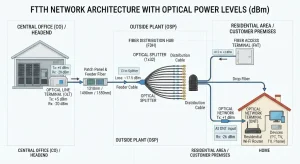
In a typical FTTH network, the Optical Line Terminal (OLT) sends optical signals through fiber cables and passive splitters to Optical Network Terminals (ONTs) installed at customer premises.
As the signal travels through the network, some of its power is lost. The total loss depends on several factors, including fiber length, splitter insertion loss, connector condition, splice quality, and other components in the optical path.
A properly planned optical power budget helps ISPs check whether the signal reaching each ONT is within the supported operating range of the equipment.
FTTH Network Architecture & Optical Power Levels.
Why Is Optical Power Budget Important for ISPs?
Optical signal problems can affect individual subscribers or multiple customers connected to the same distribution network. Without proper testing, technicians may replace an ONT or reconnect a cable without identifying the actual cause.
Understanding the optical power budget helps ISPs:
- Identify potential signal loss during network planning.
- Detect weak optical signals before they cause repeated faults.
- Troubleshoot LOS alarms and intermittent connectivity.
- Reduce unnecessary equipment replacements and repeat site visits.
- Maintain more consistent service quality across the FTTH network.
A good optical budget does not prevent every fiber fault, but it gives technicians a useful starting point for identifying signal-related problems.
Common Causes of Optical Signal Loss in FTTH Networks
1. Fiber Cable Length and Condition
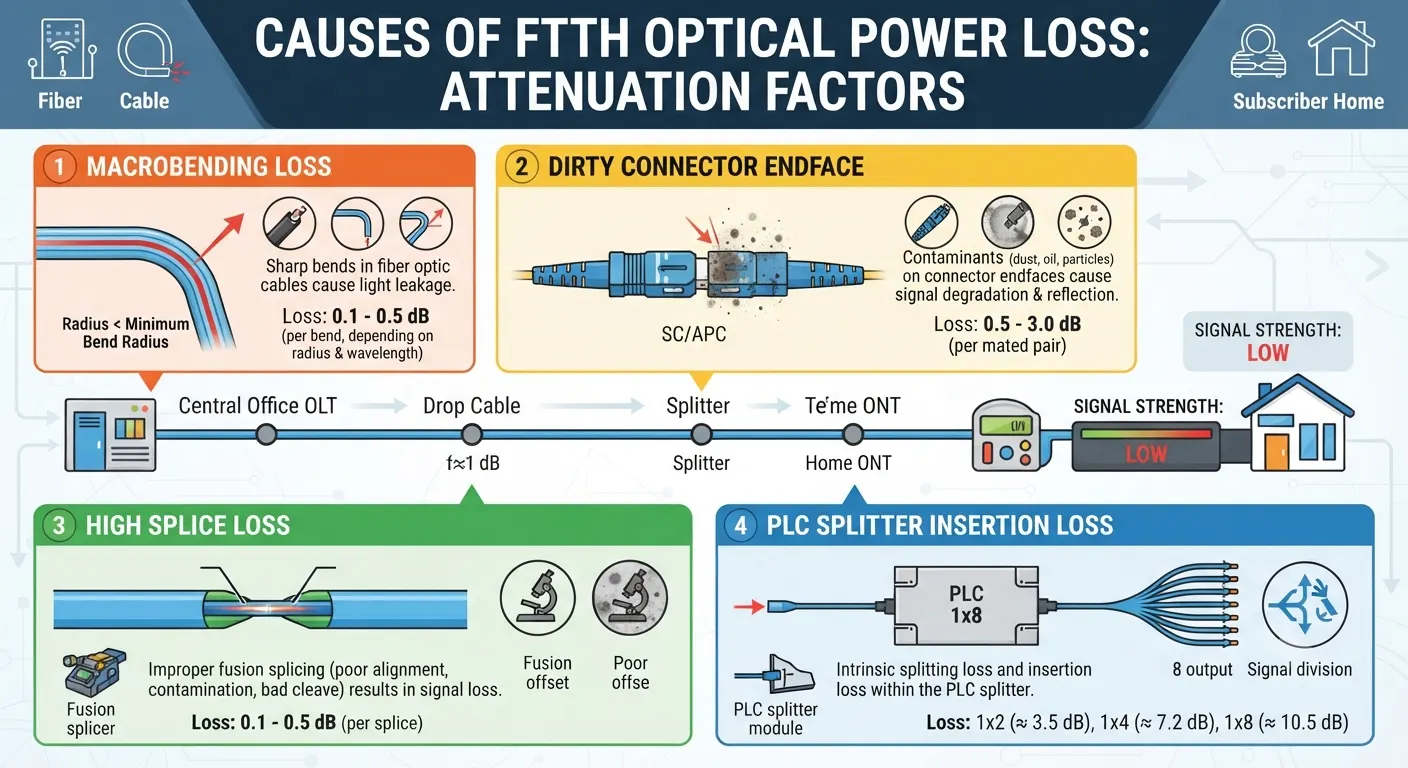
Optical signals gradually lose power as they travel through fiber. Longer fiber routes generally introduce more attenuation, while damaged cables or poor installation practices can create additional losses.
Sharp bends, crushed drop cables, and excessive pulling during installation may also affect signal performance.
What ISPs can do: Inspect the fiber route, follow the cable manufacturer’s installation guidelines, and check for visible damage or tight bends.
2. Splitter Insertion Loss
Passive splitters distribute optical signals to multiple subscribers. Because the incoming signal is divided among output ports, splitters introduce insertion loss.
The actual loss depends on the splitter’s specifications and configuration. Poor-quality components or incorrect installation can create additional problems.
What ISPs can do: Verify the splitter model, inspect its connections, and check whether the network design supports the required optical performance.
3. Dirty or Damaged Connectors
Dust, oil, and other contamination on fiber connector end faces can affect optical transmission. Loose connections or damaged connector surfaces may also contribute to signal loss.
These problems can be overlooked during routine maintenance, especially when connectors are repeatedly unplugged and reconnected.
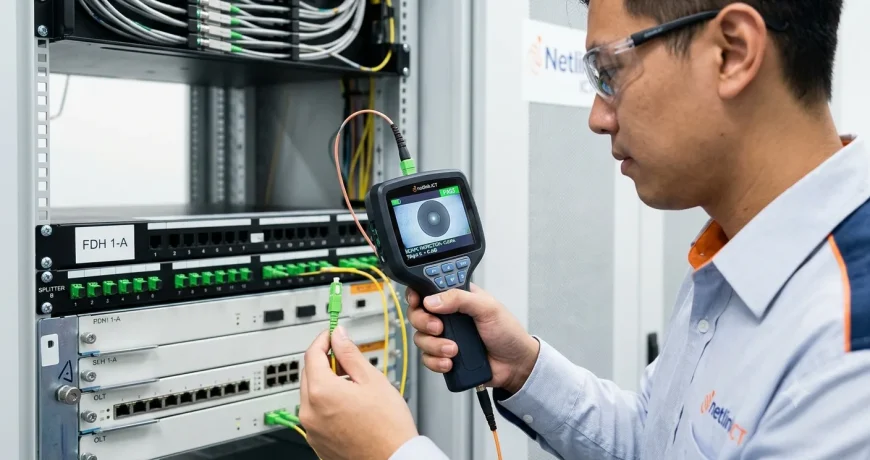
What ISPs can do: Inspect and clean connectors using suitable fiber-cleaning tools and procedures. Always inspect the connector before reconnecting it.
4. Poor Fiber Splicing
Splices connect sections of fiber cable along the network. Poor splice quality, damaged fiber ends, or improper handling can increase signal loss and create unreliable connections.
A fault at a distribution point may affect several subscribers, depending on the network layout.
What ISPs can do: Follow proper fusion-splicing procedures and use suitable testing equipment to verify the quality of completed work.
Understanding Optical Power Loss in FTTH Networks
In an FTTH network, the optical signal travels from the service provider’s equipment to the customer’s premises through fiber-optic cables. During this journey, the signal may lose some of its strength due to fiber cable length, splitters, connectors, and splices.
If the signal loss becomes too high, customers may experience unstable connectivity, LOS alarms, or service interruptions.
Understanding optical power loss helps ISPs identify potential issues during network planning and installation. By checking signal levels at important points in the network and following equipment specifications, technicians can detect problems early, maintain stable connectivity, and reduce repeat fiber faults.
Best practice: Always compare measured optical signal levels with the recommended operating range of the installed equipment. Proper installation, clean connectors, good splicing practices, and suitable network design can help maintain reliable FTTH performance.
How to Check Optical Power in an FTTH Network
Optical power testing helps technicians determine whether the signal level is suitable for the equipment and network design.
Follow these practical steps during troubleshooting:
1 Check the OLT and ONT status: Review device alarms and connection status before changing the network configuration.
2 Measure the optical signal: Use a suitable optical power meter to measure signal levels at the appropriate test points.
3Compare the readings with equipment specifications: Check the supported transmit and receive power ranges for the installed OLT and ONT.
1Inspect the fiber path: Examine connectors, patch cords, splitters, splices, and visible cable damage.
2 Identify the root cause: If the measured signal is outside the expected range, isolate the affected section and test it systematically.
3 Record the results: Document the measurements, corrective action, and final signal status for future maintenance.
Optical power readings should always be interpreted in the context of the equipment specifications and network design. A single reading may not identify the exact location or cause of a fault.
For more practical troubleshooting advice, read our guide to 7 common FTTH ONT problems and how ISPs can fix them.
Best Practices to Reduce Repeat Fiber Faults
Preventing recurring optical faults requires consistent installation, testing, and maintenance practices.
- Plan the optical link carefully: Consider fiber routes, splitters, connectors, and the supported optical limits of the equipment.
- Maintain connector cleanliness: Inspect and clean fiber end faces before making connections.
- Avoid excessive fiber bending: Follow the cable manufacturer’s minimum bend-radius recommendations.
- Verify splice quality: Use appropriate splicing techniques and testing procedures.
- Monitor optical levels: Investigate unusual changes in signal readings instead of waiting for customer complaints.
- Maintain fault records: Record recurring issues, affected subscribers, optical measurements, and repair details.
- Train field technicians: Ensure technicians follow consistent installation, testing, and maintenance procedures.
For additional recommendations, explore our guide on how to reduce signal loss in FTTH networks.
How the Right FTTH Equipment Supports Network Reliability
Reliable FTTH performance depends on more than the optical power budget alone. ISPs also need compatible OLT and ONT equipment, correct provisioning, quality fiber components, and a well-planned distribution network.
Selecting equipment according to the network’s requirements can simplify deployment, monitoring, and maintenance.
When evaluating FTTH equipment, consider:
- Compatibility between the OLT and ONT.
- Supported optical transmit and receive power ranges.
- Required PON technology and network capacity.
- Available monitoring and management features.
- Manufacturer documentation and technical support.
ISPs can explore Netlink ICT’s FTTH networking product catalogue to review available OLTs, ONTs, splitters, optical power meters, and other fiber networking products.
Conclusion
An FTTH optical power budget is an important part of planning and maintaining a reliable fiber network. It helps ISPs understand expected signal loss, assess optical performance, and identify potential problems before they develop into recurring service issues.
By measuring optical power, checking equipment specifications, maintaining connectors, verifying splices, and inspecting the fiber path, technicians can troubleshoot more effectively and reduce avoidable repeat visits.
For ISPs, the goal is not simply to restore a connection when it fails. It is to identify the underlying cause, correct the problem, and maintain a more reliable network for every subscriber.
Explore Netlink ICT for FTTH networking products and solutions designed for ISPs and network professionals.