
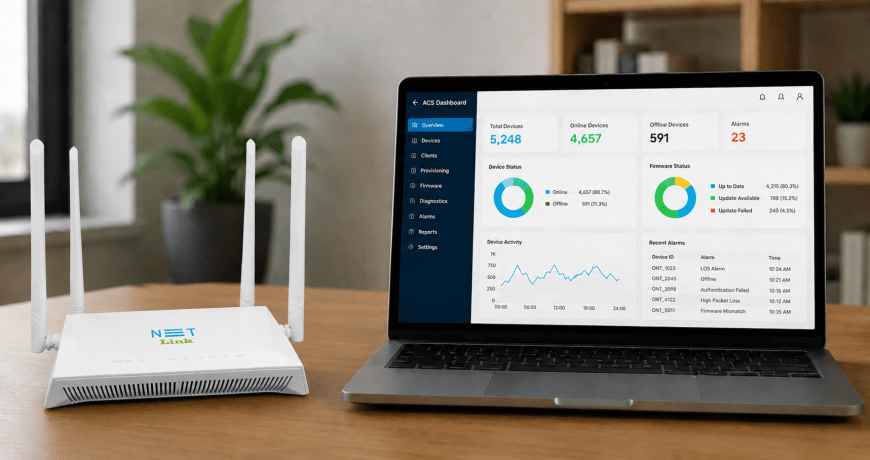
What Is TR-069? Understanding Remote ONT Management in Modern FTTH Networks Leave a comment
What Is TR-069? Understanding Remote ONT Management in Modern FTTH Networks
Introduction
As Fiber-to-the-Home (FTTH) networks continue to expand, Internet Service Providers (ISPs) face a growing challenge: managing thousands of connected devices efficiently while maintaining high service quality.
Traditionally, many network issues required on-site visits from technicians. Whether it was a configuration change, firmware upgrade, or troubleshooting task, every service call consumed valuable time and operational resources.
This is where TR-069 comes in.
TR-069 is a remote device management protocol that allows ISPs to monitor, configure, troubleshoot, and update customer-premises equipment (CPE), such as ONTs and routers, from a centralized platform. By enabling remote management, TR-069 helps service providers improve efficiency, reduce costs, and deliver a better customer experience.
In this article, we’ll explore what TR-069 is, how it works, and why it has become an essential technology for modern FTTH networks.
What Is TR-069?
TR-069 (Technical Report 069), also known as CWMP (CPE WAN Management Protocol), is a standardized protocol developed by the Broadband Forum for the remote management of network devices.
It enables communication between customer devices and a centralized management server, allowing service providers to manage devices without needing physical access to the installation site.
TR-069 is commonly used with:
- GPON ONTs
- Wi-Fi Routers
- Gateways
- Modems
- Access Points
By creating a secure communication channel between devices and a management server, TR-069 simplifies network operations and improves service delivery.
Why Is Remote Device Management Important?
As subscriber numbers grow, manually managing network devices becomes increasingly difficult.
Without a centralized management system, ISPs often face challenges such as:
- Frequent technician visits
- Increased operational costs
- Manual configuration errors
- Time-consuming firmware upgrades
- Longer troubleshooting processes
- Reduced customer satisfaction
TR-069 addresses these challenges by enabling remote visibility and control over deployed devices.
How Does TR-069 Work?
TR-069 relies on communication between two key components:
Customer Device (ONT)
The ONT installed at the customer’s location continuously collects operational data, including:
- Device status
- Firmware version
- Signal information
- Network configuration
- Performance statistics
Auto Configuration Server (ACS)
Key Benefits of TR-069 for ISPs
Faster Troubleshooting
One of the biggest advantages of TR-069 is the ability to diagnose and resolve issues remotely.
Instead of immediately dispatching a technician, support teams can access device information, identify potential issues, and often resolve problems without an on-site visit.
This reduces downtime and improves support response times.
Lower Operational Costs
Field visits involve transportation, labor, scheduling, and operational expenses.
By resolving many issues remotely, ISPs can significantly reduce service costs and improve operational efficiency.
Simplified Device Provisioning
TR-069 enables automatic device provisioning.
When a new ONT is connected to the network, it can automatically receive predefined settings from the ACS, reducing installation time and minimizing configuration errors.
Centralized Firmware Management
Keeping network devices updated is critical for both performance and security.
TR-069 allows service providers to:
- Push firmware updates remotely
- Schedule updates during low-traffic periods
- Update multiple devices simultaneously
- Maintain consistent software versions across the network
Improved Customer Experience
Faster issue resolution and more reliable service directly contribute to higher customer satisfaction.
When customers experience fewer disruptions and quicker support, trust in the service provider naturally increases.
Security Benefits of TR-069
Network security remains a top priority for modern service providers.
TR-069 supports security initiatives through:
Remote Security Updates
Critical firmware and security patches can be deployed remotely, helping protect devices against emerging threats.
Centralized Configuration Control
Administrators can ensure devices maintain secure and standardized configurations across the network.
Continuous Device Monitoring
Ongoing monitoring helps identify unusual activity and potential issues before they impact service quality.
Better Network Visibility
With centralized management, service providers gain greater insight into device health, network performance, and operational trends.
A Real-World Example
Consider an ISP serving 5,000 subscribers across multiple regions.
Without TR-069
- Manual device configuration
- Frequent technician visits
- Time-consuming firmware updates
- Higher operational costs
- Longer support resolution times
With TR-069
- Remote device provisioning
- Centralized monitoring
- Faster troubleshooting
- Automated firmware management
- Reduced field service requirements
The result is a more scalable, efficient, and customer-friendly network operation.
The Role of TR-069 in Future FTTH Networks
As FTTH deployments continue to grow, automation and centralized management will become even more important.
Future broadband networks will rely heavily on:
- Automated device provisioning
- Real-time monitoring
- Remote diagnostics
- Predictive maintenance
- Scalable network management
TR-069 provides the foundation for these capabilities, helping ISPs prepare for future network demands while maintaining operational efficiency.
Conclusion
TR-069 has transformed the way Internet Service Providers manage ONTs and other network devices.
By enabling remote monitoring, centralized configuration, automated provisioning, and firmware management, it helps reduce operational costs while improving network reliability and customer satisfaction.
For service providers building modern FTTH networks, TR-069 is more than just a management protocol—it is a valuable tool for delivering scalable, efficient, and high-quality broadband services.
As subscriber expectations continue to rise, remote device management technologies like TR-069 will play an increasingly important role in the future of broadband connectivity.